
Roosevelt Walk Out
Roosevelt Walk Out
BY Tatiana Villaseñor-Carrillo
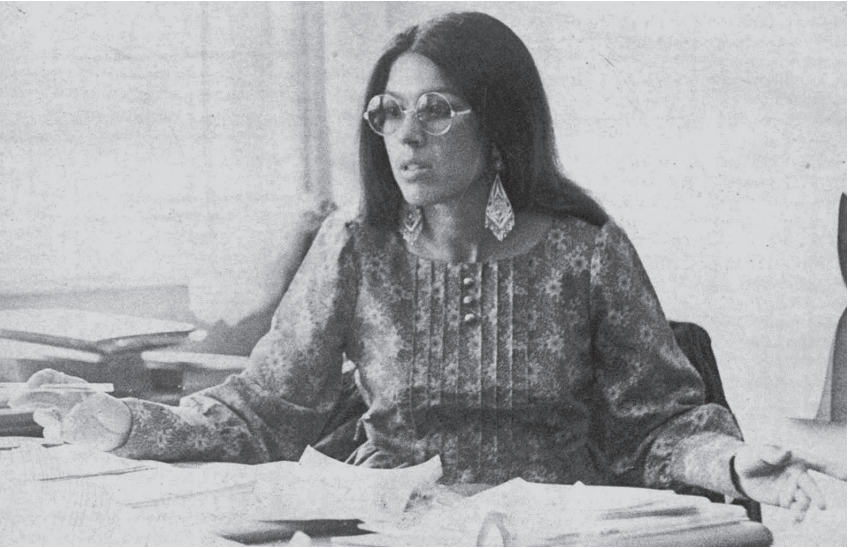
Consuelo Rodriguez returned home in 1967 to Eastside San José after graduating from Chico with a Bachelor's Degree and a teaching credential. Her pathway to becoming a teacher was strengthened by experiences in her undergraduate career and the drive to give back to the community that raised her in Downtown. This led her to the San Jose Unified School District office, where she expressed her interest in teaching at her former junior high school, Roosevelt.
The principal overheard the conversation and was stunned. Roosevelt was the place most hoped to avoid. Consuelo understood that returning to Roosevelt meant returning to her community, and to the students who needed to see someone like themselves standing at the front of the classroom. There were no openings. Still, the principal agreed to hire her.
On her first day back on campus, Consuelo entered the teachers’ lounge and, to her surprise, discovered that her role model and revered black educator, Nettye Goddard, was still teaching. When Consuelo was a student in Nettye’s classroom she would stand up for her friend Bubbles and the other girls from the neighborhood that the school system was pushing out. Nettye, guiding a young Consuelo, counseled her into seeing that she had potential. Their embrace was a full circle moment.
Consuelo’s approach to teaching reflected her appreciation for every child and the empathy she carried from her own experiences. She understood firsthand the challenges junior high students faced when they stepped outside her classroom—racist schooling environments, unstable or abusive home lives, and a broader society that discriminated against them for who they were.
Soon, the principal placed her classroom at the edge of campus, closer to Coyote creek. Students who had been kicked out of other classes or were on the verge of ditching were welcomed into her room—un refugio.
While Consuelo did her best to support students being pushed out of other classrooms, some teachers took notice of what they perceived as “special treatment,” including the aide assigned to help her manage the growing number of students seeking support. Meanwhile, the school’s racial climate grew increasingly polarized, and students began to feel restless.
By the spring of 1968, racial and political tensions had intensified in San José and around the world. The Vietnam War became known as America’s first “living-room war” because the media brought graphic TV reports and battlefield images into millions of homes. Mexican American/Chicano young men were drafted, served, and died at disproportionately higher rates, because educational and economic inequalities left fewer eligible for college deferments. According to the data, Mexicans constituted approximately 17%–20% of San José’s population— well more because nunca nos cuentan bien—yet they remained severely underrepresented at San José State College (SJSU). Chicanos made up less than 1% of the student body.
Tensions reached a boiling point in the Barrios of East LA and in March of ‘68; an estimated 22,000 students and their communities began a series of Walk Outs which culminated in a mass Blow Out of 4 high schools demanding dignity and fair treatment at the same time. Downtown San José was inspired and Roosevelt began to organize.
Consuelo was in conversation with fellow teacher José Carrasco and community organizer Sofía Mendoza. The Roosevelt Students were becoming increasingly restless. The education system abused them for speaking their first language, continued to whitewash their names, and reinforced racial stereotypes that ensured they were to remain in poverty and end up in the system. During local community meetings, the Chicano teachers voiced concerns about the systemic oppression their students faced. Mendoza, known for her commitment to El Movimiento, encouraged educators to identify student leaders—young people with the courage and influence to mobilize their peers.
During an all time high, the principal called for a school-wide assembly to discuss the intolerance that divided the school. During the gathering, one brave Chicana student stood up and shouted, “WALK OUT!”
Her voice ignited the room. The students stepped into their power and rose up. Roosevelt began chanting in unison: “WALK OUT! WALK OUT! WALK OUT!” They began to march. With a safety plan already in place, members of the Brown Berets were nearby to provide security for the young protesters. Consuelo recalls the principal being present, pleading that the students remain safe.
The movement leaders led students to nearby William Street Park, where the Chicano educators facilitated a healing circle to allow for students to express their frustration, hopes and dreams. Teachers were instructed to ensure students were brought safely back to school. The following day, students at San José High School also walked out. Their walk out was covered by the media, because it didn’t end peacefully.
Later on that year, 11 Chicanos walked out of San José State Commencement Ceremony. SOMOS el legado de la resistencia.