
Four Directions of Healing
Four Directions of Healing
BY Angelina Loyola
“Who told you that you had no value…and more importantly, why did you believe them?” A simple dicho from one of my Chicana/o Studies professors, yet when it left her mouth, it flew across the room like a fire-lit spear. It pierced the layers of internalized oppression I didn’t even know I was carrying, awakening a consciousness I didn’t know I was ready for. The realization hurt, but that pain became a doorway. A beginning. A path that had been waiting for me long before I recognized it.
Fast forward, I am approaching my tenth year teaching Chicana/o Studies across San Jose’s community colleges and universities - serving our community, paying forward what was given to me. As a Chicana/o Studies professor, I hold sacred the privilege of creating spaces where our community scholars can breathe, question, remember, and heal. Spaces where identity is reclaimed, and critical awareness grows, where our history is honored, where our people feel the dignity they’ve been denied.
In times like these, when our gente are being hunted, when fear hovers over our barrios like a low cloud - these spaces become essential. Places where our young people feel seen, heard, and valued. Places where we remind them, and ourselves, that we are not alone. That we come from fuerza, from generations who held their heads high even in the darkest moments.
“Places where we remind them, and ourselves, that we are not alone. That we come from fuerza, from generations who held their heads high even in the darkest moments. ”
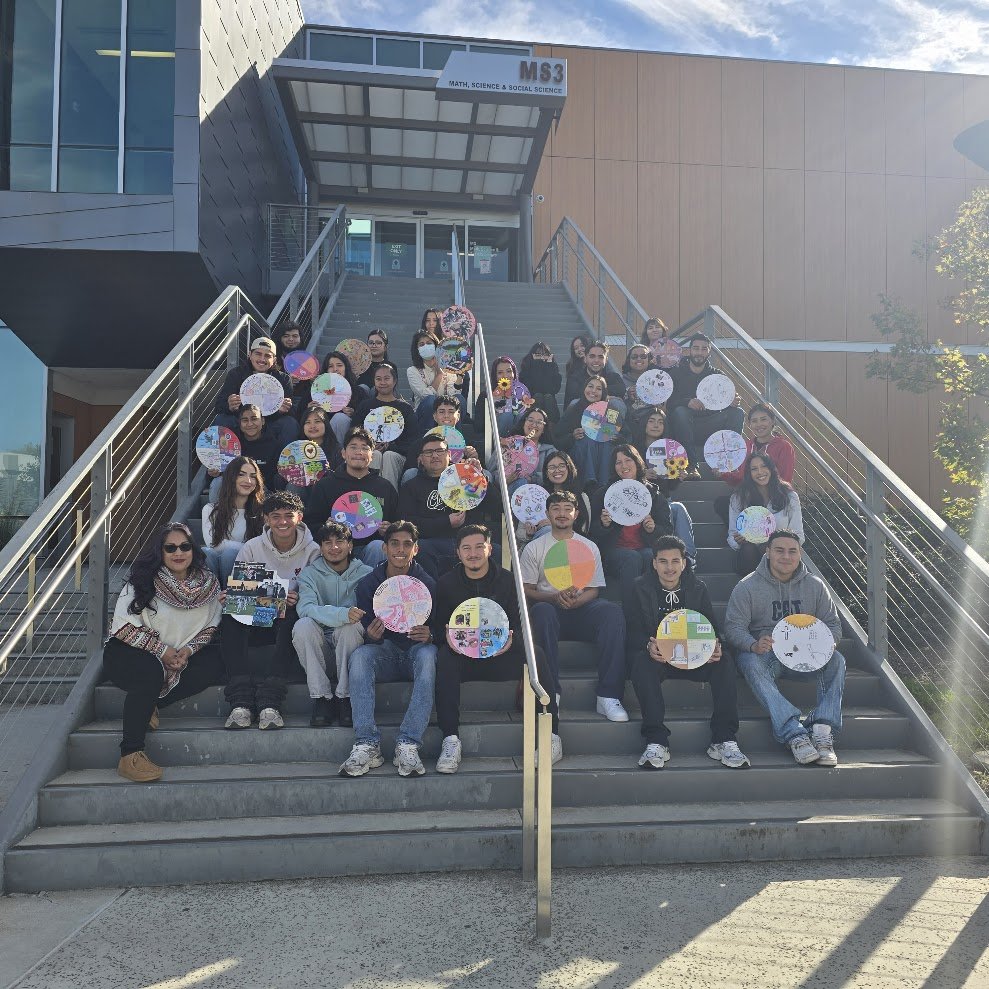
At the end of each semester, we close sixteen weeks of heartwork with the Indigenous framework of Nahui Ollin - the Aztec/Mexica philosophy of constant movement and transformation. Students explore:
Tezcatlipoca – self-reflection and clarity
Quetzalcoatl – knowledge and humility
Huitzilopochtli – intentional, positive action
Xipe Totec – transformation through shedding & new understanding
They apply their lived experiences to these concepts in their Chimal (Mexica warrior shield), creating art that mirrors the movement of their own lives. Their shields, or Chimalli, are creative artworks that represent protection, strength, resilience, courage, honor & identity. Metaphorically, they also represent emotional boundaries - what we protect within ourselves and what we present to the world.
During our presentations, we laugh, we cry, we see ourselves in each other. Our wounds look familiar - generational trauma, fractured relationships, loss, poverty, identity struggles. Many share their parents’ migration stories, heavy with sacrifice and resilience. These wounds may hold scars, but they are still healing - and in that healing, we experience radical love.
Students begin to understand that their struggles are not signs of weakness but the roots of their strength. They speak of identity journeys that lead them back to culture and tradition. They talk about shifting perceptions of mental health and how many are seeking therapy not just for themselves, but for their families. They transform “Ni de aquí, ni de allá” into “De aquí y de allá”—with pride, with power!
“They talk about shifting perceptions of mental health and how many are seeking therapy not just for themselves, but for their families. They transform “Ni de aquí, ni de allá” into “De aquí y de allá”—with pride, with power! ”
They embrace self-love, spiritual growth, faith, aspiration, and transformation. And each semester, I am reminded that dignity and integrity are not things we give our students - they are things already alive within them, simply waiting for a space to rise.
Find your space – find your tribe. They exist.